What hard and soft bounces mean for cold email, which bounce rate is acceptable, and the verification-first workflow that keeps your list clean.
7 min read
Table of contents
- Where to Next
- Hard Bounces vs Soft Bounces
- What Bounce Rate Is Acceptable for Cold Email
- Bounces Sit Upstream of the 0.3% Complaint Line
- Verification Happens Before the Send Not After the Bounces
- The Bounce Workflow
- Related reading
- Frequently Asked Questions
- What bounce rate is too high for cold email?
- Do soft bounces hurt deliverability?
- Should I send to catch-all addresses?
- What's the difference between a bounce and a spam complaint?
- Does verification guarantee zero bounces?
- How fast do bounces damage a domain?
- Where to Start
Every hard bounce tells a mailbox provider your list is unmanaged, and unmanaged lists are where filtering problems start. Keep hard bounces under 2%, the widely used industry ceiling (Mailchimp and peers), and treat a climb toward that line as a stop sign, not a statistic. The downstream consequence has a published number: Google requires bulk senders to keep spam complaints below 0.3%, and dirty lists are how senders drift there. Before sending, run your copy through Reachfold's free Spam Score Checker — it flags trigger phrases with plain-English fixes.
A bounced email is one the receiving server refused and returned with an SMTP error code. Hard bounces are permanent: the address doesn't exist and never will. Soft bounces are temporary: a full mailbox, a downed server, a message that's too large.
Key Takeaways
- Hard bounces are permanent failures: remove immediately, suppress forever. Soft bounces are temporary: retry with spacing, then drop.
- The working ceiling is 2% hard bounces per campaign, the widely used industry ceiling (Mailchimp and peers); no provider publishes an official threshold.
- Google caps bulk-sender spam complaints at 0.3%; bounce-prone lists feed that number and feed spam traps.
- Verification happens before the send: grade every lead valid, risky, invalid, or catch-all before it's saved, and re-verify lists older than 30 days.
Where to Next
- Building lists that never bounce in the first place: sources, hygiene, verification.
- Warming the inboxes that will carry the volume: how to warm up an email domain.
- Reading the bigger picture bounces feed into: why emails go to spam, and the fixes.
Hard Bounces vs Soft Bounces
The type of bounce decides the action, and confusing them is how lists rot. Hard bounces carry 5xx codes: the mailbox doesn't exist, the domain is dead, the address was typo'd. Soft bounces carry 4xx codes: temporary conditions that often clear on retry.
| Bounce type | What causes it | What to do |
|---|---|---|
| Hard (permanent, 5xx) | Address doesn't exist, domain expired, typo'd mailbox | Remove immediately, suppress permanently, never retry |
| Soft (temporary, 4xx) | Mailbox full, server down or busy, message too large | Retry with increasing spacing, drop after repeated failures |
| Policy block | Provider rejects on IP or domain reputation, not the address | Stop the campaign, diagnose reputation, don't hammer retries |
| Catch-all acceptance | Server accepts every address, real delivery unknown | Treat as risky, cap their share per campaign, watch for delayed bounces |
The catch-all row deserves emphasis. A catch-all server says yes to everything, so it verifies clean and bounces later, or worse, it never bounces and just files your mail somewhere no one reads. Hard bounce: delete. Everything else is a retry decision.
What Bounce Rate Is Acceptable for Cold Email
Two percent hard bounces is the working ceiling. Google publishes its complaint line; no provider publishes an official bounce threshold, so the working number stays the 2% industry ceiling (Mailchimp and peers), held below, per campaign. Above that line, list quality problems compound: filters start reading your sends as unmanaged, and unmanaged lists earn scrutiny everywhere else.
Track the number per campaign, not per month (what to watch daily). Averages forgive the send that kills you.
Bounces Sit Upstream of the 0.3% Complaint Line
The bounce-complaint-filter chain runs in one direction. Dead addresses inflate bounces. Abandoned mailboxes on dead domains become recycled spam traps, and hitting traps damages reputation independent of volume (spam trap types and avoidance). Recipients who never wanted the mail hit the report button, and complaints climb toward Google's 0.3% bulk-sender ceiling (Google, Email sender guidelines), measured in Postmaster Tools.
One mechanical fix helps both numbers: a one-click unsubscribe header under RFC 8058. Recipients who can leave in one click rarely reach for the report button.
Every hard bounce you prevent is a trap, a complaint, or a filter hit you never meet.
Verification Happens Before the Send Not After the Bounces
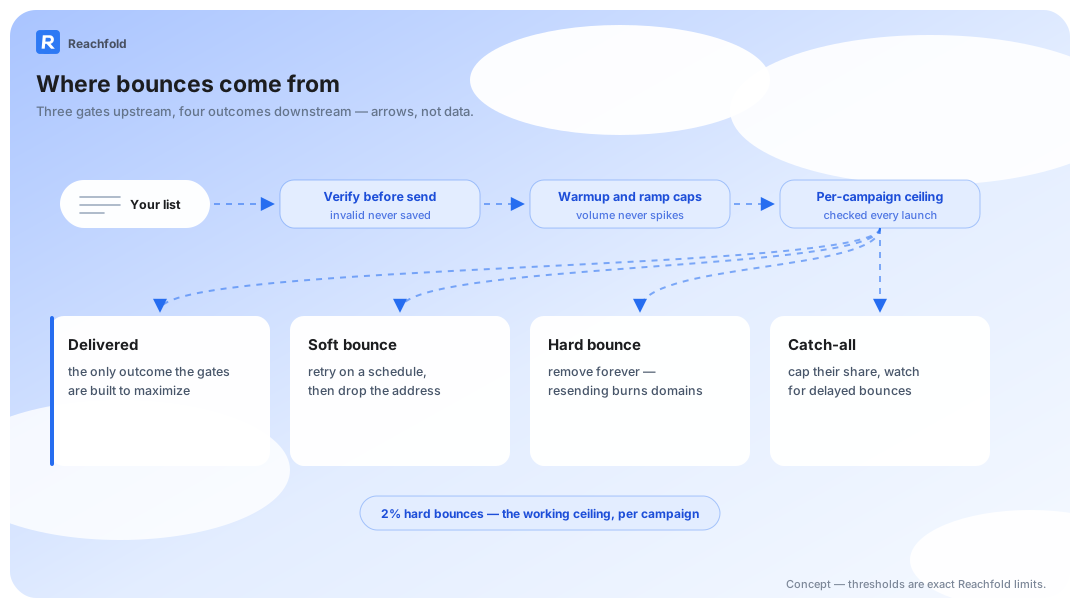
Verification belongs upstream of the send, not downstream of the bounces. Grade every lead before it's saved: valid, risky, invalid, or catch-all. Keep the history per batch, so a list built in March can be re-checked before a July relaunch. That's how we run it — we build Reachfold: every lead sourced through Reachfold passes the email-verification service gate before it's saved, and a lead that fails verification costs you nothing.
The cheapest bounce is the one you never bought.
The Bounce Workflow
Run it in order. Skipping steps just moves the pain downstream.
- Verify before the send, every list, every time. Post-send cleanup is archaeology, not prevention.
- Save valid addresses only, and cap risky and catch-all addresses to a small slice of any single campaign.
- Warm new inboxes before real volume, because fresh inboxes bounce on capacity alone.
- Ramp gradually within sane daily sending caps; a sudden spike reads like a spam run to filters.
- Remove hard bounces automatically and suppress the address forever (reputation damage compounds).
- Track bounce rate per campaign; pause any send that crosses your ceiling before the next one fires.
- Re-verify lists older than 30 days before reuse. Decay is silent, and verification snapshots expire.
Verification first, caps second, deletion third. Skip the order and the bounces pick it for you.
The pain lands as a surprise: bounce rate crept from 1% to 3% across two campaigns, placement softened, and nobody was watching per campaign. Averages hide the send that does the damage, which is why the ceiling gets checked before each send fires, not at month-end. That's the gate we run on every campaign.
Old lists are the quiet source. A list built in March decays silently, and a July relaunch mails mailboxes that died in April. Re-verify anything older than 30 days before reuse; every batch keeps its verification history, so the re-check is one click. We re-verify on that schedule ourselves, every week.
Frequently Asked Questions
What bounce rate is too high for cold email?
Treat 2% hard bounces as the widely used industry ceiling; Mailchimp and peers teach it, and no provider publishes an official threshold. Above that, list quality problems compound fast, and providers start reading your sends as unmanaged. Track the number per campaign rather than monthly: a 0.8% average can hide one Tuesday at 6% that did the actual damage.
Do soft bounces hurt deliverability?
A single soft bounce is routine; servers fill up and reboot. What hurts is the pattern: the same address soft-bouncing across sends reads as decay, and heavy soft-bounce rates can signal capacity problems on your side. Retry with spacing, then drop chronic soft bouncers instead of mailing them forever.
Should I send to catch-all addresses?
Treat them as risky, not as valid. Catch-all servers accept every address, so they verify clean and tell you nothing about the specific mailbox. Cap their share of any campaign, watch for delayed bounces, and cut them first when a send misbehaves. They're the quietest source of surprises.
What's the difference between a bounce and a spam complaint?
A bounce is a server refusing your message before delivery. A complaint is a recipient reporting your message after delivery. Bounces measure list quality; complaints measure relevance and permission. Google's 0.3% bulk-sender ceiling applies to complaints, but dirty lists push both numbers up together.
Does verification guarantee zero bounces?
No. Verification is a snapshot, and mailboxes die after it runs. Catch-all domains accept anything, full mailboxes soft-bounce, and typos resolve to real but wrong addresses. Verification removes most hard bounces before the send, which is exactly why per-campaign bounce monitoring still matters.
How fast do bounces damage a domain?
One campaign to a purchased list can register within days, and sustained rates in the high single digits read as spam behavior. Providers react to trajectory as much as totals: a clean sender drifting upward gets watched before it gets filtered. Pause at your ceiling, re-verify, and resume slow.
Where to Start
Clean list, warm domain, quiet volume: the bounce math is the foundation of the whole deliverability stack, and bounces are the input that starts every other problem. Verify before you send, hold the 2% line, and read the full picture in why emails go to spam. The enforced version, verification gates built into sourcing, runs on every paid pricing tier.