How to warm up an email domain: verify DNS, warm with real replies from your target audience while campaigns start on day one, and verify placement.
10 min read
Table of contents
- Where to Next
- Prerequisites: The DNS Gate Comes First
- Two Ramps: The Traditional Four Weeks and the Day-One Two-Lane Model
- Why the Volume Curve Stays Irregular
- Health Guards: What Pauses the Ramp
- When to Stop Warming Up an Email Domain (Never Fully)
- Warmup Myths That Burn Domains
- New Domain Email Sending Limits, Stated Plainly
- Ramp Boring, Verify the Result
- Related reading
- Frequently Asked Questions
- How long does it take to warm up an email domain?
- Can I send cold email campaigns during warmup?
- What happens if I stop sending for two weeks?
- Is a warmup network a substitute for ramping my own domain?
- How many emails can a new domain send per day?
A brand-new domain that sends cold volume on day one lands in spam by day two, and rebuilding a burned reputation costs more than the domain ever did. Warmup is the fix, and the fix has two shapes: the traditional four-week ramp that holds campaigns back, and the modern kind that warms your domain with real replies from your target audience while campaigns start on day one. Here's the process: prerequisites, both ramps, the guards, and the honest answer to "when do I stop?" (never, entirely). To see what your own meeting target costs each way, Reachfold's free Outbound Cost Calculator compares an in-house SDR, a lead agency and Reachfold side by side.
Warming up an email domain is the controlled process of building sending history on a new or long-idle domain: light volume that looks human and replies deliberately invited. In the traditional peer-to-peer (P2P) model, campaigns wait until mid-ramp. In the real-lead model, reply-bait emails to your actual market do the warming from day one, so commercial email can start the same day at a scaled pace. Either way the goal is a volume curve that looks human to mailbox providers.
This is the complete email warmup guide: prerequisites first, then both ramp models, then the guards that keep a ramp from becoming a burn. For the full comparison, see real-lead warmup vs traditional warmup.
Key Takeaways
- Warm a domain on day one without a warmup network: reply-bait emails earn real replies from your target audience while campaigns start at a few sends per mailbox.
- The traditional baseline: mailboxes warm up gradually over about four weeks before campaigns join mid-ramp, so mailbox providers never see a spike.
- Growth stays human-shaped either way: no spikes, no machine regularity, replies invited from day one.
- Health guards pause the ramp when signals degrade: bounces, complaints, falling placement.
- You never fully stop warmup; mature mailboxes keep a small trickle permanently, and a long pause sets warmup back.
Where to Next
- Warming a domain with no network at all → the no-network warmup method
- Starting from day 0 tomorrow → the warmup timeline explained
- Sizing the mailbox fleet → how many cold emails per day
Prerequisites: The DNS Gate Comes First
Don't send a single warmup email until the domain passes four checks. Warmup on a broken domain just teaches providers to filter you faster.
- Authentication, aligned. One SPF record with 10 or fewer lookups, DKIM at 2,048 bits or larger, DMARC matching your From domain (RFC 7208, RFC 6376, RFC 7489). Record syntax lives in the SPF, DKIM, and DMARC cold email guide.
- Domain age of 30+ days. Fresh registrations draw scrutiny, so wait out the 30 days before warmup starts.
- A clean blacklist screen. A hit on Spamhaus, Barracuda, or SORBS blocks sending until it's cleared.
- Provider requirements met. Google and Yahoo require all three authentication records from bulk senders, enforced with filtering rather than warnings (Google, Email sender guidelines).
The gate takes an afternoon. Skipping it costs a domain.
Two Ramps: The Traditional Four Weeks and the Day-One Two-Lane Model
The ramp most senders know is the traditional P2P-era baseline. It works, and it's still what most tools run:
| Phase | When | What happens |
|---|---|---|
| Seed | Week 1 | A plain-text trickle. No links, no images, no tracking. Every email invites a reply. No campaigns. |
| Early ramp | Week 2 | Volume climbs in small daily steps. Replies matter more than volume here. |
| Growth | Weeks 2-3 | Short HTML allowed as trust builds. Still no campaigns. |
| First campaigns | Mid-ramp | Campaigns join at a small share of daily volume; health guards stay active. |
| Full capacity | Week 4 | Volume reaches human-paced daily limits shared by warmup and campaigns. |
| Mature | Week 5 onward | The limit holds steady, and warmup continues in the background permanently. |
The trade the traditional model asks for is time: two to four weeks of paying for a domain that can't carry commercial email, with trust built from an exchange between mailboxes that can evaporate when your first campaign looks nothing like the warmup traffic.
The day-one two-lane model keeps every pacing rule and changes where the engagement comes from. Lane one sends reply-bait micro-emails — plain text, zero links, one small question — to real people from your target audience, and their replies warm the domain from day one. Lane two is your commercial campaigns, which start the same day at a few sends per mailbox and climb on a human curve to roughly 30–40 sends a day, spaced 15–45 minutes apart. The mechanics are in reply-bait cold email; the full method is in how to warm up a domain without a warmup network.
Our email warmup feature runs both lanes automatically on every connected mailbox, because the failure we've watched kill more domains than any filter is the manual ramp dying in week two, when someone ships a campaign early or a well-meaning teammate doubles the volume. Automation doesn't get impatient.
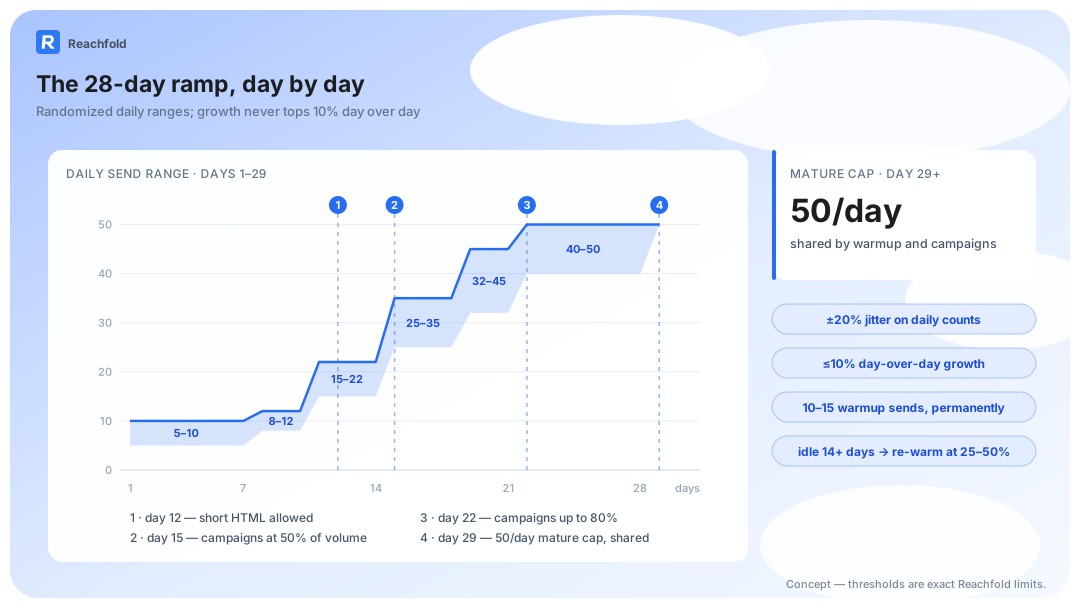
Why the Volume Curve Stays Irregular
Mailbox filters don't score your volume; they score its shape. An account that sends exactly the same number of emails every day, forever, describes a script. So each day's send count varies naturally, and growth stays gentle even at the phase jumps. The same logic applies to replies: warmup emails are written to earn responses, because replies are the strongest positive signal a new mailbox can generate. A ramp without replies is just slow spam. Run the curve by hand and its failure mode finds you — someone forgets a long weekend, and the volume flattens into machine regularity exactly when a provider review lands. Automated ramps don't forget weekends.
Health Guards: What Pauses the Ramp
A ramp without brakes is a burn plan. Three signals run continuously during warmup, and each one can hold or pause the ramp:
| Signal | Healthy | Watch | Pause |
|---|---|---|---|
| Hard bounce rate | Steady and low | Creeping up | Too high: warmup pauses |
| Complaint rate | Near zero | Occasionally elevated | Rising: warmup pauses |
| Inbox placement | Stable or rising | Declining | Falling hard: warmup pauses |
A hold freezes volume until the signal recovers; a pause stops ramp growth, waits, then resumes at the last healthy level. The bounce math is in bounce rates explained.
Guards fire before you lose the domain, which is the only outcome worth paying to avoid. They only work if nothing can talk its way past them at 6 p.m. on launch day, which is why they're system-enforced in Reachfold: traffic pauses when a signal trips and resumes at the last healthy level. A brake you can override by mood is not a brake.
When to Stop Warming Up an Email Domain (Never Fully)
The honest answer to "when do I stop?" is: you don't. What changes at maturity is the ratio, not the fact. The mailbox settles at human-paced daily limits shared between warmup and campaigns, and a small share of those sends stays warmup forever — hygiene that keeps engagement signals alive between campaigns.
""Mature" has a concrete exit criterion, and it isn't the calendar alone: the ramp is done when you verify the result with a placement test on a seed pool — a checking step, not the achievement. Why a measured test beats a guess: warmup vs placement tests; per-provider scores: measured inbox placement.
Stopping warmup entirely is how mature mailboxes become burned ones.
Warmup Myths That Burn Domains
Three myths do most of the damage:
- "A warmup network replaces a ramp." A network rents you other people's mailboxes to simulate engagement. The engagement isn't yours, the history never attaches to your domain, and providers can read the pattern. What replaces the network isn't nothing — it's real leads: reply-bait emails to your target audience, whose genuine replies warm your own mailboxes. Reachfold doesn't operate or sell a warmup network; the full case against pools is in why warmup networks can hurt deliverability.
- "One week is enough." The end of week one is still a plain-text trickle with campaigns held back in the traditional model, and even under day-one campaigns the volume curve has only just started climbing. The verification test doesn't care how impatient you are. Week one is the seed, not the harvest.
- "More mailboxes beat a ramp." Forty new mailboxes don't create forty histories; they create forty ramps. Volume without history is a spike wearing a costume. Add mailboxes when you need capacity, ramp each one, and size the fleet against how many cold emails per day.
Every myth buys speed, and every one bills you later.
New Domain Email Sending Limits, Stated Plainly
Provider hard limits are separate from warmup caps, and you'll hit the warmup cap first: consumer Gmail caps at 500 recipients per day, paid Google Workspace at 2,000 (Google; Workspace); Microsoft publishes no equivalent for consumer Outlook.com. The full breakdown is in Gmail and Outlook rate limits for cold email. Treat provider caps as ceilings: deliverability decays long before a hard limit trips.
Ramp Boring, Verify the Result
The schedule works because it refuses to be interesting: low volume that looks human, replies over links, guards that stop growth before filters do. Run the DNS gate first, pick your ramp — traditional or two-lane — and let a placement test verify where the mail actually lands. The full verification system is in the cold email deliverability guide.
Next step: check your domain age and DNS today, then start the reply lane tomorrow morning — and under the two-lane model, your first commercial sends leave the same day. Plans are on pricing.
Frequently Asked Questions
How long does it take to warm up an email domain?
Under the day-one two-lane model, your first commercial sends leave on day one at a few per mailbox, and volume climbs on a human curve from there — reputation building continues and is verified, not waited out. Under the traditional four-week ramp, mailboxes reach mature volume at the end of week four, campaigns join mid-ramp, and a small trickle of warmup emails continues permanently after that.
Can I send cold email campaigns during warmup?
With real-lead warmup, yes: campaigns start on day one at a few sends per mailbox and climb alongside the reply lane. In the traditional model, campaigns join partway through the ramp, once the mailbox has built a base of clean history, and share the human-paced daily limit with warmup at maturity. Either way, never jump a fresh mailbox straight to full volume.
What happens if I stop sending for two weeks?
A long pause sends the mailbox back into a partial re-warm before campaigns resume. Filters treat silence followed by a burst as suspicious, so the ramp rebuilds the history curve first. Plan long breaks around the re-warm window, not after it.
Is a warmup network a substitute for ramping my own domain?
No. A network rents engagement from strangers' mailboxes, so the sending history never attaches to your domain, and providers read the pattern as manipulation. What replaces the network is real engagement: reply-bait emails to your target audience, whose replies build history on your own mailboxes. External warmup services can complement a ramp; none of them replace a real one.
How many emails can a new domain send per day?
On day one under the two-lane model, a few commercial sends per mailbox alongside the reply-bait lane, climbing to roughly 30–40 a day at maturity, shared by warmup and campaigns. Provider hard limits, like Gmail's 500 recipients a day, are ceilings rather than targets. Deliverability decays well before you reach them.